

Any hospital that offers cardiac surgery, ECMO, or organ transplant needs a perfusionist available around the clock, either in-house or on call within a set response time. To cover some or all of that call, many hospitals contract with an outside perfusion company to cover it.
Generally, this is a smart approach. Perfusionists are in short supply, and staffing 24/7 call takes more people than many programs can recruit or justify on their own. But not every perfusion company staffs call the same way. Some use an arrangement called shared call coverage, which hospitals may not be aware of. It holds up most nights, but when it fails, it can leave a hospital without coverage when it's needed most.
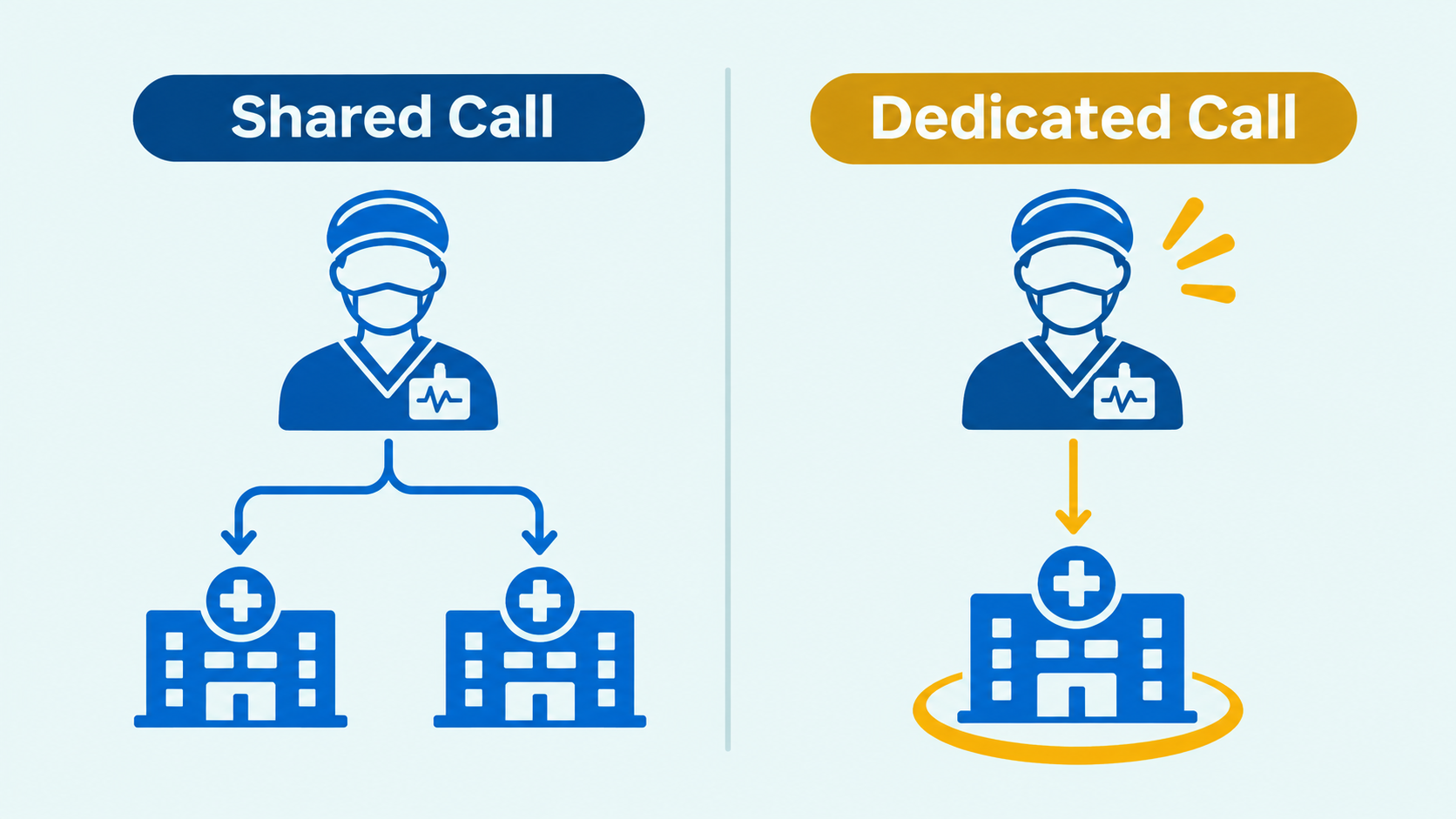
Perfusion Life takes a different approach. Every on-call perfusionist covers one hospital at a time, so the perfusionist on a hospital's schedule is there for that hospital alone.
What is Shared Call Coverage?
Shared call coverage means a perfusion company puts one perfusionist on call for two or more hospitals in the same area at the same time. It’s a cost-cutting measure, since paying one perfusionist to cover several hospitals is cheaper than staffing each one separately.
The arrangement isn't always clear to the hospitals involved. Each hospital sees a name on its call schedule and a response-time commitment in its contract, and assumes that perfusionist will be there whenever it calls. But in reality, two or more hospitals may be counting on the same person at the same time, and only one of them can have that perfusionist when emergencies overlap.
When two hospitals call at once, the one left without coverage often has no warning until the response time has already been missed. Some arrangements list a backup perfusionist, but a backup may not have the same response time. Either way, if both hospitals call, one of them will be delayed.
What Shared Call Coverage Means for Patients
The cases that bring in an on-call perfusionist are some of the most time-sensitive in medicine. Aortic dissections, ECPR, emergency surgery after a failed PCI, and sudden heart or lung failure requiring ECMO all depend on support arriving fast. For an acute type A aortic dissection, the risk of death rises the longer a patient goes without surgery. For ECPR, the time between the start of CPR and the start of ECMO is strongly linked to whether a patient survives with good neurological function.
When two calls overlap, the second patient can face a long wait. A perfusionist running a bypass case or starting ECMO can’t hand off the pump and leave, and some emergency cases last many hours. In the meantime, the care team at the second hospital has to choose between difficult options. They can wait, try to transfer an unstable patient to another facility, or try to find another perfusionist on short notice.
Every patient who needs emergency perfusion support is someone’s parent, spouse, or child, often with family in the waiting room counting on the team to be ready. Patient safety depends on call coverage that holds up every hour of every day, including the hours when two emergencies happen at once.
Evaluating Perfusion Coverage Proposals
When hospitals compare proposals for perfusion call coverage, price is usually the easiest number to compare side by side. Staffing models, backup plans, and how a company handles overlapping calls are much harder to see from the outside.
Dedicated call coverage costs more because it takes more people. A lower price doesn't always mean shared call coverage, but it's a good reason to ask how a company staffs its call.
Hospitals reviewing a new proposal, or a contract already in place, can learn a lot by asking a few direct questions.
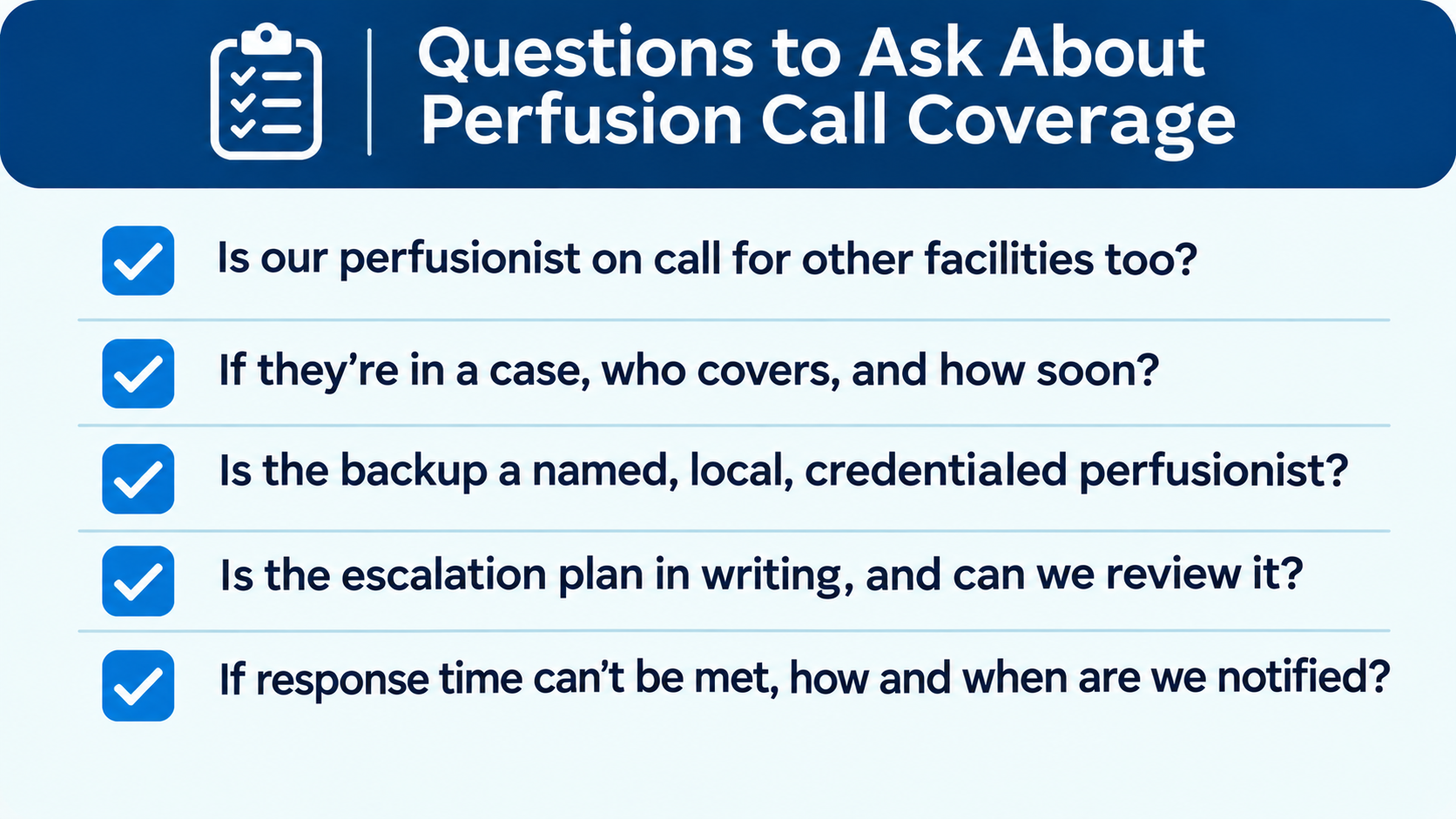
Questions to Ask
- Is the perfusionist on call for our hospital also on call for any other facility during the same shift?
- If our on-call perfusionist is in a case when we page, who comes, and how long does that take?
- Is the backup a named, local, credentialed perfusionist, or someone who would need to travel in?
- Is the escalation plan in writing, and can we review it before we sign?
- If a response time can’t be met, how and when will we be notified?
A company offering dedicated coverage can answer the first question with a simple “no.”
How Perfusion Life Covers Call
Perfusion Life does not use shared call coverage. When one of our perfusionists is on a hospital's call schedule, that perfusionist is on call for that hospital alone.
Perfusion Life is part of Integration Health, which acquired Perfusion Life in March 2026. Our network includes more than 1,700 credentialed perfusionists across the U.S. and Canada. Together, Integration Health and Perfusion Life now provide ECMO, perfusion, and NRP services to more than 100 facilities nationwide. That network gives us the depth to staff call the way hospitals deserve and expect.
Every page to an on-call perfusionist has a patient behind it, and often a family in a waiting room counting on the team to be ready. Our coverage is built so that the answer to that page is always yes.